By Joseph Chirume.
Qgeberha
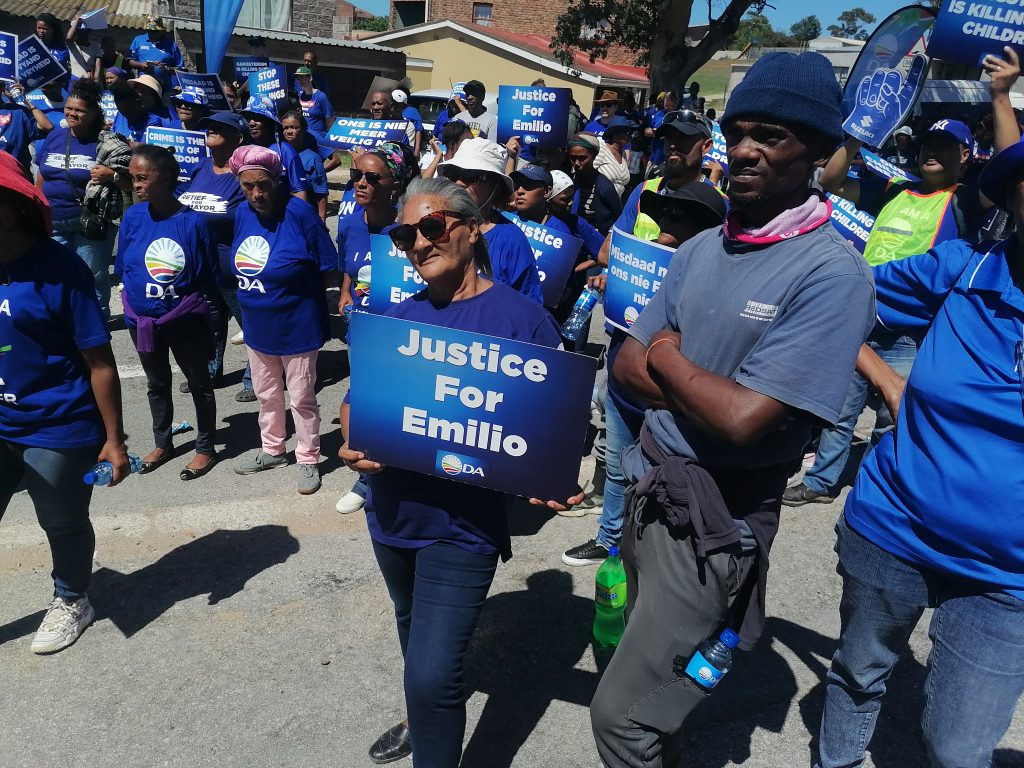
Residents of the Northern Areas in Nelson Mandela Bay, protested outside the Gelvandale Police Station on Monday, demanding urgent action to end gang violence. Led by the Democratic Alliance (DA) and community activists, the protesters handed a petition calling on President Cyril Ramaphosa for the deployment of the national army to assist police.
This is after residents felt overlooked by President Ramaphosa’s State of the Nation Address last week, where he announced army deployments in Western Cape and Gauteng provinces, but not in Nelson Mandela Bay.
The petition also urged Acting Police Minister Firoz Cachalia to implement resolutions passed by the National Assembly three years ago to bolster police resources.
DA MPL and PE Northern Areas Constituency leader, Yusuf Cassim stated that the area remains a crime hotspot emphasizing that the lives of NMB residents also matter.
The residents said that Minister Cachalia was correct when he said gang violence in NMB mirrored that of the Western Cape during his visit to the region early this month.
Cassim said, “Last week during President Cyril Ramaphosa’s State of the Nation Address, he announced that there would be deployment of the army in Western Cape and Gauteng in order to support the efforts of the police against gang violence in those provinces, but he left out the Northern Areas of Nelson Mandela Bay which has been ravaged by gang violence for many years.
“We demand that this area be prioritized to fight gang violence. Our point to the President is that when he is deploying the army to help police fight gang violence in other provinces, he cannot ignore this area. Our lives also matter.”
“We don’t believe the deployment will solve the issue but it can stabilise the situation. Gangs have taken over communities with substance abuse becoming a scourge tearing apart families.”
One of the mothers affected by gang violence is community coordinator Elsudi Camealio whose son was murdered on 16 February 2022 in Schauderville. The 37-year-old son was volunteering alongside Camealio at a local community hall where they were feeding homeless people during the Covid-19 pandemic.
“Today is exactly four years after my son was murdered in cold blood. He was not a gangster but was assisting me to care for the homeless people during Covid-19.
“I am still shattered because he left two intelligent children, a boy and a girl whom I am struggling to provide for. That tragedy severely affected his eldest son who had to fail grade 11 three times. He however made it this time and passed with a Bachelor pass.
“Drugs are fuelling violence in our area. As a community we’re trying to teach our kids about the harm caused by substance abuse but it seems the situation keeps worsening. My son’s death left an indelible mark in my life and each time I hear the sounds of gunshots that memory flickers back. At times I think that if an opportunity arises to relocate to a safer place I would take it because the Northern Areas carry a bad memory and dark history for my family.”
Randall Williams has a painful and long history of gang violence affecting his family. He lost his three brothers in a succession due to the violence.
Williams explained, “This story affects every living member of my family. My brothers stayed here in Gelvandale.
“The other thing that traumatises victims’ families is that convicts are just released back to communities without informing victims’ families. This creates fear in communities. The government should also have a program to assist families of victims to cope with the trauma.”
Ward 32 councillor, Pieter Hermaans said gang violence has escalated to such an extent that some children have dropped out of school in fear.
“Just recently, two young boys were murdered here in Gelvandale in cold blood. They stayed in the same street. This is just one example. There’s too much gang violence here. It is now affecting scholars because they have to pass through more than five gang controlled areas to and from school where they are constantly harassed. This is the reason we have a high rate of school drop-outs,” said Cllr Hermaans.
The petition was handed to the NMB District Commissioner, Major General Vuyisile Ncata.
It demanded that, “President Ramaphosa acknowledges that the lives of the people of the Northern Areas do matter by deploying the army on a short-term basis to create stability, he commands Acting Minister Cachalia to enforce Parliament’s solutions without delay.
“We request the President and the Acting Minister to give feedback on how this memorandum will be actioned within the next 14 days.”
But Major General Ncata said dangerous crimes like murder had reduced in NMB. He also appealed to protesters not to hide wanted criminals.
Ncata said, “Whatever affects us as the police, we’re going to do it. Let me say that crime and gangsterism are not police issues, but societal issues. Without the involvement of us as the parents, the police are not going to win against gangsterism because the gangsters that we’re talking about are raised by you. There are even families who hide them when police are looking for them. Our vehicles here have been stoned on many occasions only for searching or tracing a wanted gang member. Some people who are here are the ones protecting gangs.”
Key 2025/2026 Statistics & Trends:
- Targeted Youth Crimes: Data reported in late 2025 indicated that within the Northern Areas, there were 73 cases of unlawful possession of firearms, 22 murder cases, and 33 attempted murder cases involving youth.
- High-Risk Zone: Gang violence continues to make this area one of the most violent locations in the Eastern Cape, with residents frequently describing themselves as “prisoners in their homes”.
- Recent Violent Incidents: As of mid-February 2026, crime in the area remains severe, with, for example, 52 killings recorded in nearby New Brighton alone in a recent period.
- Kidnappings: Kidnapping cases in the Nelson Mandela Bay metro increased from 14 to 35 in the second quarter of 2025, with many being ransom-motivated.
- Firearm Violence: Firearms remain the primary instrument of murder, accounting for a high volume of cases in the broader region.
Regional Context:
- Gangsterism: The area is characterized by an entrenched, often “glorified” gang culture, with rival gangs frequently exchanging gunfire.
- Police Intervention: Due to the high rate of violence, including the shooting of a toddler in a gang-related incident, there have been ongoing calls for specialized, long-term intervention. Operation Pamba (150 officers) was deployed in early 2025 to address crime in, among others, the Northern Areas.
- Correctional Overcapacity: The St Albans Medium Prison in Port Elizabeth has been reported as being 194% over-capacity, highlighting issues with housing the high number of arrested suspects.
These statistics, particularly relating to gang violence and illegal firearm possession, confirm that the Northern Areas remain a critical crime hotspot in the Eastern Cap
Based on recent 2025/2026 data, the Northern Areas of Gqeberha (Port Elizabeth) continue to face high levels of violence, primarily driven by gang activity, with specifically high murder and attempted murder cases involving youth
. The Northern Areas are considered one of the most violent locations in the Eastern Cape, with residents frequently citing that gang violence keeps them as “prisoners in their own homes”.
Latest developments by 17 February 2026
The Democratic Alliance (DA) through its Shadow MEC for Community Safety said it welcomes the announcement by Acting Police Minister Firoz Cachalia confirming that President Cyril Ramaphosa has acceded to the DA’s demand to expand the planned military deployment to now also include the Eastern Cape, to support the South African Police Service in combating gangsterism.
According to the DA this follows sustained pressure from the organisation and communities in Nelson Mandela Bay’s Northern Areas, who have long called for urgent national priority intervention to address the ongoing gang violence crisis.
“While the deployment of the army can provide short-term relief and has the potential to bring much-needed stability to communities that have been living under siege for far too long, it cannot resolve the root causes of gangsterism. The safety and dignity of residents must remain the priority, and immediate stabilisation is a necessary first step.”
The DA further extended its sincere gratitude to the many community members who came out in their numbers to make their voices heard during the “Do Our Lives Not Matter?” rally and memorandum handover at Gelvandale Police Station.
“Their courage and unity sent a clear message that residents’ lives in the Northern Areas cannot continue to be ignored. The memorandum made clear that, although army intervention is not a solution to the carnage, it would provide essential stability, and it also called for the urgent implementation of the binding parliamentary resolutions adopted in July last year. These resolutions directed SAPS to address the collapse of the Anti-Gang Unit and Crime Intelligence capacity in Nelson Mandela Bay, yet no meaningful action has followed.”
The DA said it will closely monitor the implementation of the deployment plan, which is expected to begin within the next ten days, and will continue to demand long-term, sustainable solutions to dismantle gang networks, restore specialised policing capacity, and ensure a whole-of-government approach to address the underlying causes of gangsterism and criminality.
“Communities in the Northern Areas deserve more than temporary intervention. They deserve lasting safety, functioning law enforcement, and a government that treats their lives as a national priority. The DA remains committed to fighting alongside residents until meaningful, permanent change is achieved.”